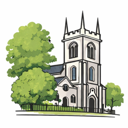
 Greenside Parish Church
Church History
From the 1456 Rude Chapel to the present day
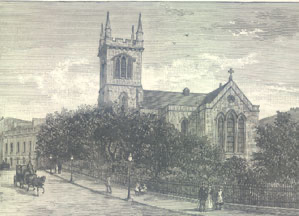
Greenside Church circa 1880

Early panoramic view of Greenside Church and the surrounding Edinburgh cityscape (19th century)
Early Religious History
The site of Greenside has a long religious history. In 1456 a "Rude Chapel" was established on the green north slope of Calton Hill, and by 1526 a Carmelite (Whitefriars) monastery grew around it.
This monastery was dissolved during the Scottish Reformation, and in 1589 the city repurposed the chapel as a hospital for lepers, completed by 1591. Thus, the "Greenside" area was known in the 16th century for its friary and later its leper house.
After the leper hospital era, the Greenside hollow remained mostly undeveloped until the 19th century urban expansion of Edinburgh's New Town.
Origins: "Greenside Chapel" (1838)
Greenside Church was founded as an offshoot of the Free Church movement in Scotland. By 1838, a group of evangelical Presbyterians in Edinburgh's Greenside neighborhood—then a rapidly developing district northeast of the city center—resolved to build their own place of worship. They secured a plot on what is now Royal Terrace (a sweeping Georgian terrace overlooking the city), and commissioned a modest Gothic Revival chapel there.
The chapel opened for worship in 1838 and was known initially as "Greenside Chapel" or "Greenside Free Church." In style, it was a simple, single-storey stone sanctuary with Gothic-arched windows, a small bell tower, and seating for several hundred worshippers.
The congregation was made up largely of local tradespeople, artisans, and working families drawn by a commitment to evangelical preaching and congregational self-governance—hallmarks of the Free Church tradition.
The Stevenson Family
Among the congregation, one prominent family stands out: the family of Robert Louis Stevenson. The famous novelist and poet spent part of his childhood in the Greenside Parish. His father Thomas Stevenson and grandfather Robert Stevenson (the eminent civil engineer) were both elders of Greenside Church, meaning they were leaders in the congregation.
Young Robert Louis Stevenson would have attended services there as a boy, and he later fondly recalled it as "the church on the hill." The Stevenson family even endowed a mission chapel for the poor of the parish at Lower Greenside in memory of Robert Stevenson – a philanthropy commemorated by a plaque inside the church. This illustrious connection to the Stevenson family is an important part of Greenside's legacy.
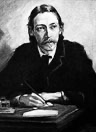
Robert Louis Stevenson
The Last of the Burgh Churches
Greenside Parish Church holds the distinction of being the last of Edinburgh's "Burgh churches" – those built by the city for the New Town during the 19th century. This makes it a significant endpoint in the story of Edinburgh's church extension movement, which saw numerous new congregations established to serve the rapidly expanding urban population.
"The parish was the last of the 'Burgh churches' – those built by the city for the New Town – opening a final chapter in the story of Edinburgh's 19th-century church extension."
Designed by James Gillespie Graham, one of Scotland's leading architects of the early 19th century, the church represents his characteristic Gothic Revival style, featuring pointed arches, decorative stonework, and a picturesque setting that complemented the surrounding Royal Terrace development.
Key Historical Dates
A "Rude Chapel" is established on the green north slope of Calton Hill, marking the first recorded religious use of the Greenside site.
A Carmelite (Whitefriars) monastery grows around the chapel, becoming a significant religious community in Edinburgh.
The monastery is dissolved during the Scottish Reformation.
The city repurposes the chapel as a hospital for lepers.
Greenside Church opens for worship (as a daughter church of St Cuthbert's). Rev. William Glover becomes the first minister, serving from 1839 until 1871.
Rev. Archibald Scott becomes minister following Dr. Glover's death. His notable tenure (1871–1880) precedes his service as Moderator of the General Assembly of the Church of Scotland in 1896.
Rev. Dudley Stuart Hopkirk serves as minister. After leaving Greenside, he becomes a Professor of Systematic Theology at Ormond College in Melbourne.
Greenside Parish absorbs several neighboring congregations during a period of church consolidation in Edinburgh.
Major overhaul and electrification of the pipe organ by Henry Willis & Son Ltd.
The organ undergoes comprehensive reconditioning and restoration by Rushworth & Dreaper Ltd.
The last full-time minister departs; services continue under interim clergy.
Greenside's congregation unites with St Andrew's and St George's West Church to form "Edinburgh: New Town Church."
The church opens to the public during Edinburgh's Doors Open Days as part of the "New Town Churches" heritage grouping.