 Greenside Parish Church
The Organ
A testament to Victorian craftsmanship
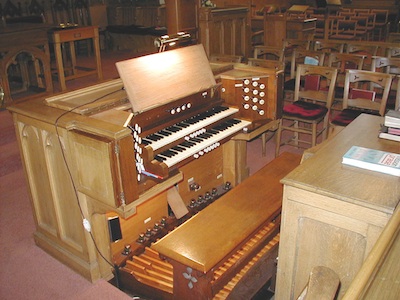
The two-manual console of the Ingram organ at Greenside Parish Church
The pipe organ at Greenside Parish Church is a magnificent instrument with 21 speaking stops, representing the finest traditions of Victorian organ building. Situated in the back of the gallery with a detached console in front of the Communion Table, it has led the praise at Greenside for generations.
Interior and Organ Placement
Inside Greenside Church, the layout is a traditional Georgian-Gothic kirk interior. A U-shaped gallery (supported by cast-iron columns) wraps around the sanctuary, and a wood-panelled ceiling with a Gothic rose adorns the nave. At the rear of the gallery sits the church's pipe organ, which has a notable history.
The Original Organ (1885)
The original organ was acquired second-hand in 1885 (likely built by A. E. Davies of Newcastle) and was installed in the west gallery. That Victorian-era organ was hand-pumped and had mechanical action; it served the congregation for almost 50 years. In 1933, the church decided to replace it and sold the old organ to St. Margaret's Church in Dumbiedykes (another Edinburgh congregation), according to session records of the time.
The Present Organ (1933)
The present organ was built new for Greenside in 1933 by Ingram & Co. of Edinburgh. It cost £1,600 and was formally opened on 8 October 1933 by Dr. William Baird Ross, the organist of nearby Broughton Place Church.
The Ingram organ is a two-manual, 21-stop instrument retaining parts of the older 19th-century organ's casework and pipework. Its console and pipes (decoratively stencilled to match the chancel's Gothic woodwork) occupy the gallery's center-rear, facing down the nave. For decades this organ led worship and was used in concerts; it was well-maintained up through the 2010s.
The church's interior furnishings – including a carved timber pulpit, communion table, and memorial tablets – remain intact, preserving the atmosphere of a 19th-century parish church.

Organ Specification - Ingram & Company Opus 1136 (1933)
1964 Overhaul and Electrification
Apart from routine maintenance and tuning, nothing further was done to the present organ until 1964 when the then organist and choirmaster, Edward Robinson, wrote to the Kirk Session a report on the state of the instrument ending it as follows:
"Finally, from a personal viewpoint, it is extremely embarrassing and nerve-wracking to sit Sunday after Sunday not knowing if the organ will last out the service. Also having to attend at the Church almost every other Saturday either with the Organ Company or alone to correct some minor fault is expecting rather a lot of the Organist."
The Kirk Session took note and Henry Willis & Son Ltd. thoroughly cleaned and overhauled the organ and completely re-electrified the console doing away with the pneumatic action. The cost was £1515 7/6.
1993 Reconditioning and Restoration
In 1992, Henry Willis & Son Ltd. suggested several tonal changes and re-voicings but the Committee on Artistic Matters recommended that these changes were unnecessary with the exception of the following:
- The Great Fifteenth was reckoned to be too "Flutey" and should be changed for a new rank of pipes which would brighten up the Great Chorus. The Fifteenth is the highest sounding stop on the organ (nominally 2').
- The Great Dulciana should be loudened during tonal finishings. The Dulciana 8' is the quietest stop on the Great Organ (unenclosed) and is normally used to accompany the Oboe stop on the Swell Organ (enclosed).
Work commenced at the beginning of August 1993 when the organ was handed over to Ivor Norridge and Jim Smail of Rushworth's. It is only when the organ is taken to pieces that one realises how many different parts there are - over 1000 pipes; each manual or keyboard has 61 notes; there are 30 pedals, 21 draw-stops for the speaking stops plus another for a tremulant, 8 draw-stops for couplers, 8 adjustable thumb pistons...and so it goes on!
Everything has to be cleaned thoroughly! The original keys to the console and the cupboards were found under the pedalboard when it was taken away to the workshop for renovation.
So, for almost the whole month of August the organ fell silent and the praise at Greenside was ably led by Muriel Aird from the piano. I began to get a little twitchy around the beginning of September - I suppose that I was suffering withdrawal symptoms - and I started to regularly visit the church. Imagine my delight one day in early September when I walked into the church and heard the lovely sounds of pipes being tuned. Not only did all the pipes have to be retuned but a new rank of pipes had to be voiced - that is a real expert's job!
I think that it was fitting that the first service with the newly renovated organ was the Joint Service of Holy Communion with London Road on 12 September 1993.
"I would like to thank the Kirk Session for heeding my pleas to have the organ cleaned and trust that it will give many more years of good and faithful service in leading the praise in God's house at Greenside. The organ always was top of my pops before I joined Greenside and I now realise what a lovely instrument it always has been - and the renovation work really has been worthwhile. It is a real joy to play!!!" — Mike Thomson
The Organ's Future
Since the closure of the sanctuary in 2024, the pipe organ is no longer needed for weekly services. The instrument is being cared for and kept intact pending a decision on the building's future. According to the British Institute of Organ Studies, because Greenside is a city-center church, efforts may be made to find a new home for the organ so it can continue to be played.
As of early 2025, the organ and its ornate case still sit silent in the Greenside gallery. If the building is repurposed or sold, the organ could be relocated to another church (its 1933 Ingram pipes and the older Harrisons parts are considered of historic interest).
Thus, the Greenside organ's story – much like the church's – is at a turning point, awaiting the next chapter. For now, it stands as a lingering echo of the church's musical heritage under the stained-glass windows and vaulted ceiling where it once rang out in song.